What Is a TIE Card in Spain? Residence Permit for Foreigners Explained
TIE (Tarjeta de Identidad de Extranjero) is Spain's residence card for non-EU foreigners. NIE vs TIE difference, who needs one, how to get it, and how to check if yours is ready. Plain English guide.
You’ve been approved for residency in Spain. Now everyone’s throwing abbreviations at you — TIE, NIE, lote, Cl@ve — and none of it makes sense yet.
This guide covers the physical card itself: what TIE and NIE actually mean, what every field on your card is for, and the one number in the top-right corner that unlocks your entire digital life in Spain.
For the waiting and tracking part — how lote numbers work and how fast different offices process — see our companion guide: What Is a Lote Number?. If you’re still waiting for your card, you can track your lote position to monitor where you are in the queue.
NIE vs TIE: The Confusion That Trips Everyone Up
These two get mixed up constantly. They are not the same thing.
NIE (Número de Identidad de Extranjero) is a number. It’s your permanent identity number in Spain, assigned once and valid for life. It follows the format X/Y/Z-1234567-A — a letter (X, Y, or Z depending on when and how it was assigned), seven digits, and a check letter. If yours starts with Y or Z instead of X, that’s normal — X was the original series, Y and Z were introduced as earlier numbers ran out. Your NIE stays the same for life — through renewals, status changes, everything.
TIE (Tarjeta de Identidad de Extranjero) is a physical card. It’s the credit-card-sized document you carry in your wallet that proves your legal residency. It has an expiration date, it gets renewed, and it contains your NIE printed on it — along with other information you’ll need.
Think of it this way: your NIE is like your identity number. Your TIE is like the ID card that displays it. You can have an NIE without a TIE (for example, while waiting for your card to be manufactured), but you can’t have a TIE without an NIE.
Who needs a TIE? Most non-EU foreigners granted residency or a long-term stay in Spain. This includes work permits, student stays (estancia por estudios — technically not “residency” under Spanish law, but still requires a TIE), family reunification, and all other standard authorization types.
Who gets a different card? Non-EU family members of EU citizens receive a tarjeta de residencia de familiar de ciudadano de la UE — similar process, different legal basis (RD 240/2007 instead of RD 557/2011). Post-Brexit UK nationals under the Withdrawal Agreement also receive TIE cards but through a separate channel.
Who doesn’t need a TIE? EU/EEA/Swiss citizens (they get a registration certificate instead), tourists under 90 days, and short-term visa holders without residency authorization.
What’s on Your TIE Card — and Why Every Field Matters
When you receive your TIE, don’t just glance at it and put it away. Check every field on the spot, at the police station, before you leave. Errors happen, and correcting them later means starting a replacement process.
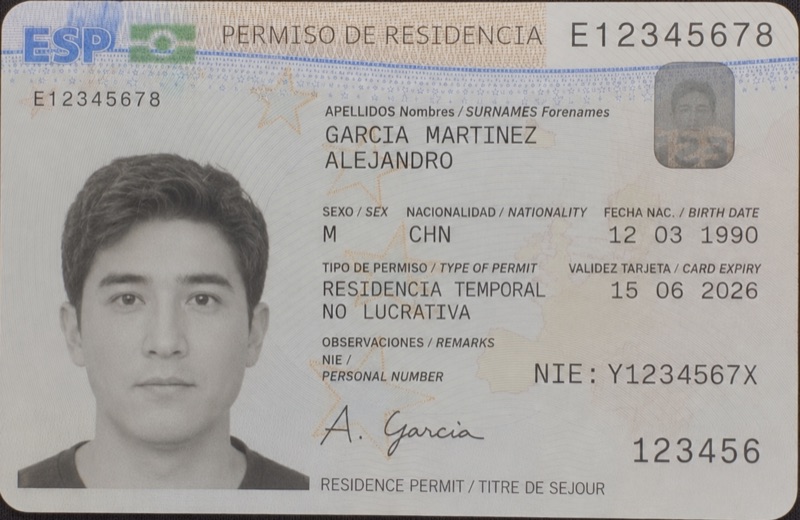
Front of the card
| Field | What to verify | Why it matters |
|---|---|---|
| Full name | Matches your passport exactly | Mismatches cause problems at banks, government offices, airports |
| NIE number | Format: X/Y/Z-0000000-A | Your permanent identity in Spain — used on tax returns, contracts, bank accounts, everything |
| Nationality | Correct country | Affects which consular services apply to you |
| Sex | H = Hombre (male), M = Mujer (female) | Errors here exist — check it |
| Date of birth | Correct | Affects age-dependent rights and benefits |
| Residency type | Matches your approval — e.g. AUTORIZACIÓN DE RESIDENCIA TEMPORAL, LARGA DURACIÓN, LARGA DURACIÓN-UE, ESTANCIA POR ESTUDIOS, FAMILIAR DE COMUNITARIO | Determines what you can do (work, travel, renew). Note: larga duración and larga duración-UE are different legal statuses |
| Valid from / Valid until | Dates correct | Your card’s validity window — don’t miss renewal deadlines |
| Address | Current registered address | Should match your empadronamiento |
| Photo | Recognizably you | 32×26mm, white background, front-facing, no glasses, taken within last 6 months. Photo rejection is the #1 reason for appointment delays |
Your signature
Your signature is collected at the police station during fingerprinting (toma de huellas) on an electronic signature pad (similar to the ones at banks) and printed directly on the card. The pad feels different from paper — practice your signature on a smooth surface beforehand. Many people sign poorly on their first attempt.
Yes, you can sign in Chinese characters. In practice, there is no language restriction — Chinese characters and pinyin are both accepted.
The practical advice: keep your signature consistent with your passport, and use the same signature across all important documents — property deeds, bank accounts, company registrations. Consistency prevents headaches down the road. Your signature should also have sufficient complexity to prevent forgery — a simple line or dot is not advisable.
Top right: the support number
The number in the top right corner of your TIE card starts with E and is followed by digits. This is your card number (número de soporte), and it’s different from your NIE.
Here’s what most people miss: this support number is required for self-registering with Cl@ve, Spain’s digital identity system. Without it, you cannot complete the online self-registration process.
Why does Cl@ve matter? It’s how you access virtually every government service online: checking your residency status, booking appointments, filing taxes, viewing your social security record, downloading your empadronamiento. If your TIE is the physical key to life in Spain, Cl@ve is the digital key.
The card number changes every time you receive a new card — whether through renewal, replacement after loss, or any reissue. Your NIE stays the same forever, but the support number is tied to the physical card. This means: if you registered Cl@ve with your old card’s support number and then get a new card, you’ll need to update your Cl@ve registration with the new support number.
What Your TIE Unlocks
The physical card is not just an ID. It’s the key that activates your life in Spain.
Digital access — through Cl@ve
Cl@ve is Spain’s unified government authentication platform. With your TIE and its support number, you can register and choose how to identify yourself online:
- Digital certificate — install an FNMT certificate on your computer for full access and legal document signing. The most powerful option. On the Cl@ve gateway, this falls under eIdentifier — the category for any qualified electronic certificate.
- Cl@ve Móvil — authenticate via the Cl@ve app on your phone. Scan a QR code or confirm a push notification. Most convenient for daily government access.
- Cl@ve Permanente — username and password, reinforced with SMS codes for higher-security operations. Easiest to set up, but the least capable.
These are not three separate systems. Side-by-side: eIdentifier vs Cl@ve. Most people use Cl@ve Móvil to look things up, and the digital certificate (via eIdentifier) when Mercurio asks them to sign, then submit an extranjería renewal (for the types it lists). ICP is appointments and lote.
To check whether the card is ready (lote), use https://sclt.es/tie/consultar/ — not the login buttons. Figures follow official data.
Life in Spain
- Banking — open accounts, resolve anti-money-laundering verification, access full financial services.
- Healthcare — register for your tarjeta sanitaria (health card) with TIE + empadronamiento.
- Driving — exchange your foreign license or take the Spanish driving test.
- Education — enroll in public language school (Escuela Oficial de Idiomas).
Each of these is a separate guide. Start with everything you can do with your TIE →
Related: How to Apply · What Is Lote? · eIdentifier vs Cl@ve · Check lote · Live Tracker →
Found an error?
Tell us what's wrong: broken links, changed requirements, incorrect contact details, or business authorization issues.